
YourSecret - Match by Mindset.
FARNORA LIMITEDSocial
4.321.00 Reviews
- Version
- 1.1.3
- Installs
- 10.00K
- Age Rating
- Teen
Screenshots


Our Review of YourSecret - Match by Mindset.
 Analysis by Appyee
I approached YourSecret - Match by Mindset as a social app for people who want to share what is on their mind without building a public identity around it. That distinction matters. Instead of beginning with a polished profile, a follower count, or a carefully chosen photo, the app is built around thoughts, moods, and interests. In my experience, that makes the first step feel lighter than it does on most social platforms.
The app is free, comes from FARNORA LIMITED, and is aimed at a Teen audience. It has a 4.3 average from around 42 ratings, with more than 10 thousand installs, so it is still a relatively small social space rather than a crowded mainstream network. It runs on Android 7.0 and later, and the current version is 1.1.3. Those details make it accessible to many older Android devices, while the modest community size gives the experience a more intimate feel.
From a private thought to a meaningful match
I find the most useful way to judge this app is to watch how a small, well-worded thought can travel from a private moment into a conversation. That makes the quality of the first contribution more important than trying to post often or sound impressive. I’d also keep expectations measured: a shared mindset can open the door, but the next section looks at what happens when the app is used more heavily.
The starting point is your state of mind
Most social apps ask me to decide how I want to be seen before I can do anything useful. I need a username, a picture, a short biography, and sometimes a list of interests that says more about my intended image than my actual mood. YourSecret takes a different route. Its central idea is to let the content of a thought, mood, or interest do the initial work.
That is especially useful when I am not looking for a broad audience. Imagine finishing a difficult day and wanting to express frustration, excitement about a niche hobby, or uncertainty about a decision. On a conventional network, I might hesitate because the post is attached to my established identity. Here, the appeal is that the starting point is the feeling or idea itself, not a profile that needs to be maintained.
The absence of a profile-centered beginning also changes what I expect from other people. I am less likely to judge a post by its photos, follower history, or carefully written biography. I pay more attention to whether the thought feels familiar and whether the mood creates a natural reason to respond. That is the strongest concept in the app: the match begins with mindset rather than presentation.
There is an important trade-off, though. A profile normally gives context. It helps me understand whether someone regularly shares thoughtful observations, jokes, advice, or personal updates. Without that layer, a single post has to carry more meaning. Some users will find that refreshing, while others may feel that every interaction starts with too little information.
How I would use it in an ordinary day
A realistic use case is a short evening check-in. I might open the app after work, identify the mood I am actually in, and write one clear thought instead of trying to summarize my entire day. The useful discipline is to avoid writing a vague sentence such as “everything is strange.” A more specific thought gives the matching process something to work with: a concern about changing routines, an interest in learning a skill, or a small success that I do not feel like announcing publicly.
That approach also helps people who are tired of performing online. I can use a thought as a prompt for connection rather than as a finished piece of content. If I want replies, I would phrase it in a way that leaves room for another person to recognize themselves in it. For example, a question about losing motivation may create a better opening than a simple statement that I am unmotivated.
My practical tip is to separate honesty from oversharing. The app’s profile-light concept may make disclosure feel safer, but I would still avoid including identifying details, contact information, or anything that could expose another person. An anonymous or low-identity environment can encourage openness, but it does not remove the need for normal online judgement.
The step-by-step flow
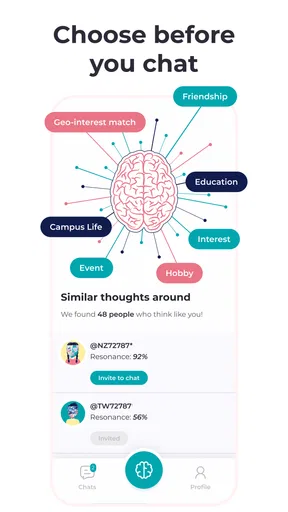
The first stage is choosing what I want to put forward: a thought, a mood, or an interest. These are not interchangeable. A thought gives people something to consider, a mood communicates an emotional starting point, and an interest can create a shared subject. Choosing the right type affects the kind of response I am likely to receive.
If I am hoping to meet someone who understands a particular feeling, a mood may be the most direct entry. If I want conversation, a thought with a little detail is more useful. If I am looking for people who enjoy the same subject, an interest provides a clearer bridge. This is one of the app’s less obvious practical lessons: the quality of the initial input may matter more than how frequently I post.
After that, the app’s promise is to connect people by mindset. I would treat the resulting connection as an invitation to explore, not as proof that another person is a perfect match. A shared mood can create an immediate sense of recognition, but it does not tell me whether we communicate well, share boundaries, or want the same kind of interaction.
The next step is reading the other person’s contribution carefully. Because the service is not centered on traditional profiles, I should not expect a complete personal history before deciding whether to continue. I would look for tone, clarity, and respect. Does the person respond to the actual idea? Do they push for personal details too quickly? Do they treat disagreement as a conversation or as a reason to attack?
That makes the experience more deliberate than rapidly scrolling through a feed. I am not simply consuming posts; I am deciding whether a particular piece of emotional or intellectual overlap is worth following. The app works best when I give each interaction a moment of attention instead of treating matches as disposable.
Where the handoffs happen
The first handoff is from my internal state to the words I submit. This is where I have the most control. If I write something too broad, the match may be weak even if the feeling is genuine. If I write something too personal, I may create unnecessary vulnerability. A useful middle ground is a concrete observation that communicates the emotion without exposing private information.
The second handoff is from my contribution to another person’s interpretation. I may intend a sentence to sound reflective, but someone else may read it as sarcastic or hostile. The less profile context there is, the more important wording becomes. Short posts can be powerful, but they can also be ambiguous. I would reread a contribution before sending it and remove phrases that depend on facial expression or private background.
The third handoff is from a match to an actual exchange. A match is only the beginning. To turn it into a useful interaction, I would ask a question connected to the original thought rather than immediately switching to personal topics. For an interest-based match, that might mean asking what drew the person to the subject. For a mood-based match, I might acknowledge the feeling and share a small related experience without trying to diagnose or fix them.
This is also where patience helps. A mindset match does not guarantee an instant conversation. Someone may connect because they recognize a feeling but still be unsure how much to say. Pressuring them to respond defeats the app’s more thoughtful premise. The best handoff is gradual: shared idea, respectful reply, then a clearer sense of whether the interaction is worth continuing.
What the result feels like
The best result is not simply meeting more people. It is finding a conversation that would probably never begin through appearance, popularity, or conventional profile details. Someone may respond to a concern because they have experienced the same thing, or notice an interest that is easy to overlook on a general-purpose network.
I also see value in the app as a low-pressure writing exercise. Putting a mood into words can help me understand it, even before another person replies. The matching element adds a social purpose, but the act of defining what I am thinking is useful by itself. For people who find large feeds exhausting, this narrower path may feel more manageable.
Another possible outcome is discovering that a supposed match is not a good fit. That is not necessarily a failure. The app can help reveal the difference between sharing a mood and sharing a way of communicating. Two people may both feel lonely but want completely different kinds of contact. Recognizing that early is healthier than forcing a connection just because the initial label appears compatible.
For this reason, I would judge success by the quality of the exchange rather than the number of matches. A single respectful conversation can be more valuable than a long list of vague connections. The app’s smaller installed base may support that feeling, although it can also mean that the range of perspectives depends heavily on who is active when I open it.
Where the flow breaks down
The biggest weakness is the same feature that makes the concept attractive: limited identity context. If I want to build a lasting network, follow a creator’s work, or return to a detailed personal page, this is not the obvious choice. Traditional social apps are better at continuity because profiles, posts, and follower relationships create a visible history.
The experience can also become frustrating when a thought is difficult to classify. Human feelings overlap. A post may be both an interest and a mood, or a personal reflection may not fit neatly into either. If I spend too much time trying to choose the perfect category, the app’s simple premise starts to feel restrictive rather than freeing.
There is a second limitation in the matching idea itself. Similarity can create comfort, but it can also narrow the conversation. If every connection reflects the same mood, I may receive validation without a new perspective. Someone who wants debate, professional networking, or a broad range of viewpoints may prefer a platform where discovery is organized around topics, communities, or public profiles instead.
Safety and boundaries also require active attention from the user. The Teen content rating signals that the app is intended for a younger audience as well as adults, so I would be particularly careful about moving conversations beyond the app or sharing details that identify where I live, study, or work. The profile-free approach should not be mistaken for complete anonymity or personal protection. I would treat every interaction as a conversation with a stranger until trust has been earned over time.
Another practical issue is community density. With over 10 thousand installs, the service has a real user base, but it is not operating at the scale of the largest social networks. That may be a benefit if I prefer less noise, yet it can reduce the chance of finding an exact match for a very specific interest or mood. Activity may feel uneven, especially for niche subjects.
Who should try it, and who should skip it
I would recommend it to someone who wants social discovery without making their image the center of every interaction. It suits reflective users, people exploring new interests, and anyone who prefers starting a conversation from a feeling or idea. It may also appeal to users who are uncomfortable posting personal thoughts to an audience made up of acquaintances.
I would be more cautious recommending it to someone seeking a dependable messaging network, a professional identity, or a public portfolio. If your main goal is to maintain contact with known friends, a standard messenger is more practical. If you want organized communities around hobbies, a forum or interest-focused network may offer stronger tools for long-term discussion. If you want dating-style certainty, a mindset match alone does not provide enough information to replace a service designed specifically for that purpose.
Parents and younger users should approach the app with the same online safety habits they would use elsewhere. The Teen rating makes it unsuitable to treat as a completely child-oriented space. I would keep conversations respectful, avoid exchanging private details, and leave an interaction when the other person ignores boundaries.
My verdict after following the complete workflow
YourSecret - Match by Mindset has a clear and appealing idea: begin with what someone is thinking or feeling instead of asking them to construct a public identity. I like that the concept encourages more meaningful first impressions and gives ordinary moods or interests a chance to become conversation starters.
Its value depends on how thoughtfully I use it. A rushed, vague input can lead to an unhelpful match, while a specific and carefully worded contribution gives the other person a genuine opening. The most important habit is to treat matching as the start of a handoff, not the final answer. I still need to judge tone, respect, boundaries, and whether the conversation develops naturally.
The app is free and easy to consider for Android users on older supported devices, and its current version, 1.1.3, shows that the project is still developing. I would choose it when I want a quieter, mindset-led way to meet people. I would choose a conventional social network when identity, history, established communities, or reliable contact with friends matters more.
My final recommendation is therefore positive but specific: try it if you are curious about connections built from inner states rather than profiles, and give the process enough time to move from a carefully expressed thought to a respectful exchange. It is most convincing when used as a doorway to one good conversation, not as another platform to endlessly collect connections.
Verdict
Strengths of YourSecret - Match by Mindset.
- Matches focus on personality and values rather than profile photos.
- Private chat helps users get to know each other at a comfortable pace.
- Daily matching can make the discovery process feel less overwhelming.
- Clean interface is easy to navigate for first-time dating app users.
- Useful for people seeking more meaningful, compatibility-based connections.
Limitations of YourSecret - Match by Mindset.
- The user base may be smaller than on mainstream dating platforms.
- Limited matches can make results feel repetitive in some locations.
- Mindset compatibility cannot guarantee chemistry or relationship success.
- Some features may require a subscription or in-app purchases.
- Inactive or incomplete profiles can reduce the quality of potential matches.
Similar Picks in This Category
View All
Meta Platforms, Inc.4.6

Instagram4.0

Likee-Live, Chat & Party Games
Likeme Pte. Ltd.4.4

Facebook Lite
Meta Platforms, Inc.4.5

TikTok - Videos, Shop & LIVE
TikTok Pte. Ltd.4.0

Moj: Free Short Drama & Reels
ShareChat4.1
Frequently Asked Questions
What is YourSecret – Match by Mindset?
YourSecret – Match by Mindset is a social and dating-focused app designed to connect people through personality, opinions, interests, and personal perspectives rather than relying only on profile photos. During testing, the concept felt centered on discovering compatibility through meaningful prompts and conversations. It may appeal to users who want more context before deciding whether to interact with a potential match.
How does matching work in YourSecret – Match by Mindset?
The app’s matching experience is based on the way users think, respond to prompts, and describe their preferences or values. Instead of judging compatibility exclusively from appearance, YourSecret encourages users to explore mindset-related information before starting a conversation. Match quality will depend on how honestly and completely you answer questions, as well as how many compatible users are active in your area.
Is YourSecret – Match by Mindset free to download and use?
YourSecret can generally be downloaded without an upfront charge, but some features may depend on the app’s current subscription model, in-app purchases, or account limitations. Before registering, it is worth checking the pricing page carefully for details about premium interactions, visibility options, messaging, or other locked tools. Availability and costs may also vary between Android and iOS.
Is YourSecret safe and private to use?
As with any app involving personal information and conversations with strangers, users should review the privacy policy and permissions before creating an account. Avoid sharing your home address, financial information, passwords, or other sensitive details in chats. Use the available blocking and reporting tools if someone behaves suspiciously, and remember that mindset-based matching does not guarantee that every profile or conversation is genuine.
Who should download YourSecret – Match by Mindset?
YourSecret may be a good choice for adults who prefer getting to know people through opinions, values, interests, and conversation instead of relying solely on photographs. It is particularly suited to users who enjoy answering prompts and taking time to evaluate compatibility. However, people seeking a large, highly established dating network or completely unrestricted features may want to compare it with other apps first.
